Douglas Roche: Carney went to the UN to advance Canada’s foreign policy, Trump went to abuse, harangue the UN in a tirade of false accusations

The author is a member and past Chair of Canadian Pugwash Group
Published in The Hill Times, September 29, 2025

Mark Carney’s four days at the UN showed his belief that Donald Trump’s aggressiveness can be fought off by strengthening Canada’s trade, energy, and security through diplomacy. When Carney returned home and went to Question Period, the opposition seemed uninterested in grilling him on what he had accomplished at the UN. 

EDMONTON—The contrast could not have been sharper. Prime Minister Mark Carney went to the United Nations in New York from Sept. 21-24, and used the organization’s convening power to advance Canada’s foreign policy interests. United States President Donald Trump went to the UN for a few hours and abused the organization in a tirade of false accusations. These two story lines intersected, and Carney emerged as a new leader in the international community.

All this has to be seen in perspective. Of course, the U.S. is the giant whose every twitch grabs the headlines. When the escalator to the General Assembly broke down on Trump and his wife, CNN led with this malfunction as a metaphor about how the UN can’t get anything done. When Carney co-chaired a meeting with Ukraine President Volodymyr Zelenskyy on the plight of the Ukrainian children stolen by Russia, this humanitarian action was treated as just a side event.

For nearly an hour, Trump stood at the green podium in the General Assembly belittling and berating the UN for its immigration and climate policies. He mocked the UN for not choosing him as the developer when the headquarters was renovated decades ago, and treated the delegates as merely an extension of his usual MAGA audience. Carney dutifully showed up at the Canadian desk to listen to Trump’s harangue and later, at his own press conference, tried to smooth over Trump’s viciousness by saying he supported the president’s efforts to bring peace to the world. Carney, who is in the midst of Canada-U.S. trade negotiations, seems very conscious of Trump’s warning, “I only do business with the people I like,” and later took his wife Diana Fox Carney to Trump’s reception for the delegates.

Carney’s principal address affirmed Canada’s formal recognition of the State of Palestine, reinforcing this country’s support for a two-state solution to build peace between Israel and Palestine. The prime minister called for an immediate ceasefire in Gaza, the release of the Israeli hostages still held by Hamas, and the rapid scale-up of humanitarian relief in Gaza. Recognizing Palestine was certainly a late action by Canada, since more than 150 countries had already done so, but in the company of the United Kingdom and France in this UN setting, Carney felt comfortable moving ahead, despite Trump’s veiled threats he would punish Canada in the trade talks for such action. Only a few days previously, the U.S. had vetoed—again—a Security Council resolution demanding an immediate, unconditional and permanent ceasefire in the Gaza Strip.

Carney’s shining moment at the UN was his co-chairing, along with Zelenskyy, a meeting of 42 states to build pressure for the return of more than 20,000 Ukrainian children abducted by Russia. Accompanied by his wife, Carney called for more international support for the International Coalition for the Return of Ukrainian Children. The meeting laid plans to embed the return of the children within broader efforts for peace, reconciliation and accountability in Ukraine.

Carney then turned his attention to a meeting of specialists on the technicalities of achieving the Sustainable Development Goals, which has become an agonizing issue for the UN because the money that should be going to development processes in the most vulnerable states is being siphoned off by the escalating arms expenditures. The world now spends $2.7-trillion annually on arms, an amount which is 750 times greater than what nations devote to the UN. In his capacity as current chair of the G7, Carney tried to shore up the mechanisms to boost human development.

Here, Carney is doing high-wire diplomacy. He has acceded to Trump’s demand that NATO states devote five per cent of their GDP to defence spending, which, in Canada’s case, will mean a quadrupling of defence spending over the next decade. This will amount to $150-billion a year. Even if a good slice of this will be in the form of strengthening infrastructure here at home, defence spending will continue to dwarf what is spent on diplomatic efforts to build peace.

Yet it was diplomacy that Carney concentrated on during his four-day New York stay. He seemed moved by UN Secretary-General Antonio Guterres’ cry, “We have entered into an age of reckless disruption and relentless human suffering,” and leaders must decide now “what kind of world we choose to build together.” He met privately with Guterres and, according to Carney’s press statement, discussed Canada’s commitment to a “strong and effective” UN. Canada currently contributes $2.2-billion to the UN annually, and is the organization’s seventh-largest donor. He announced $207-million in new international assistance to improve global children’s nutrition and to address climate change.

The current UN financial crisis is caused by the U.S. defaulting on $1-billion in payments, and the Trump administration’s plans for a $1-billion cut in future assessments. This has already caused Guterres to lay off 15 per cent of UN staff. Trump, in his tirade against the UN, said not a word about America cutting back its payments.

China is stepping up its involvement in the UN administration and outreach. It was notable that Carney had a private meeting with the Premier of China, Li Qiang, to discuss canola, seafood and electric vehicles. This meeting laid the groundwork for a possible summit between Carney and China’s president Xi Jinping. If such a meeting were to occur, it would confirm Canada’s swing to renewed cooperation with the world’s second-largest economy, a move clearly designed to offset Canada’s economic dependence on the U.S.

Carney also met with the leaders of Namibia, Kenya, Barbados, Jamaica, Haiti and Malaysia in a burst of meetings that strengthened this country’s network of UN relationships. His four days at the UN showed his strong belief that Trump’s aggressiveness can be fought off by strengthening Canada’s trade, energy, and security through building networks of action with the UN at the core.

That is a message that desperately needs to be broadcast across the country, but I’m not sure it has been heard. When Carney went straight to Question Period in the House of Commons on his arrival back from New York, the opposition seemed not the least interested in grilling the prime minister on what he had accomplished at the UN.

Senator Douglas Roche’s latest book is Keep Hope Alive: Essays for a War-free World (Amazon).

The Hill Times


CPG: Canada Must Say No to ‘Golden Dome’ Strategic Missile Defence — A Call for Parliamentary Oversight

Canadian Pugwash Letter

Ahmed Hussen, Chair
Standing Committee on National Defence

Charles Sousa, Chair
Standing Committee on Foreign Affairs and International Development
House of Commons

Dear Chairs,

On behalf of the Canadian Pugwash Group, I am writing to express our grave concern about the Government of Canada’s movement toward participation in the United States’ proposed strategic ballistic missile defence initiatives within “Golden Dome”.

Recent reports suggest that the government is considering removing long-standing restrictions on strategic missile defence, paving the way for Canadian direct involvement in those elements of Golden Dome or similar schemes. Negotiations are reportedly already under way.

This situation raises profound questions of accountability and oversight. To date, there has been no parliamentary debate, committee review, or public consultation on whether Canada should commit tens of billions of dollars to what would be one of the most expensive and controversial military programmes ever launched. Decisions of this magnitude cannot be allowed to proceed with so little attention or accountability.

Read full letter here: CPG_Letter_GoldenDome_ParliamentaryOversight_Sept2025

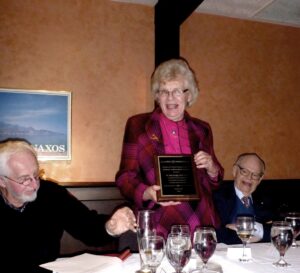
Douglas Roche, O.C. Named 2025 Winner of CLND Award for Distinguished Achievement in Nuclear Disarmament


Douglas Roche, O.C. Named 2025 Winner of CLND Award for
Distinguished Achievement in Nuclear Disarmament:

Presentation and Lecture in Ottawa on October 23, 202

July 17, 2025

Douglas Roche, O.C. will receive the Canadian Leadership for Nuclear Disarmament (CLND) 2025 Distinguished Achievement Award. He has devoted himself over many decades to the vital cause of nuclear disarmament and, ultimately, the global abolition of nuclear weapons. CLND is a civil society initiative sponsored by the Canadian Pugwash Group. It is endorsed by more than 1,000 recipients of the Order of Canada who have called for Canada to work for comprehensive negotiations for the elimination of nuclear weapons.

“We are immensely proud to give this year’s Award to Douglas Roche, honouring his unwavering and inspiring leadership, for more than 50 years, resolutely focused on ridding the world of its catastrophically deadly arsenal of nuclear weapons,” said Alex Neve O.C., CLND Chairperson. “There is no one who has been so steadfast, brought so many others to this vital campaign, and shown all Canadians the moral clarity and pragmatic necessity of the cause. Doug Roche embodies the very epitome of the essence and finest qualities of leadership. And he has ardently and eloquently shown us all just what is at stake: our very survival.”

Douglas Roche has had the rare distinction of serving in the three roles of a Canadian Member of Parliament, Ambassador for Disarmament and Senator. He received appointments from two prime ministers of different parties: Brian Mulroney appointed him ambassador and Jean Chretien named him a senator. In all of those roles he has been a clarion voice for peace, justice and human rights, and has been untiring in his determined effort, in particular, to advance nuclear disarmament.

Roche, who is also a former Visiting Professor at the University of Alberta, has been a lifelong educator, informing Canadians of the risks posed by nuclear weapons and policy options to lessen those risks. He has written 25 books, and multiple articles and speeches. To strengthen disarmament education, he has organized many Parliamentary breakfasts, civil society meetings, roundtables, seminars, and briefings. He holds nine honorary doctorates and is an Officer of the Order of Canada.

Roche has also been integral to the creation of a wide range of effective nuclear disarmament advocacy groups. He was founding Chairperson of  Parliamentarians for Global Action, the Middle Powers Initiative, and the Canadian Network to Abolish Nuclear Weapons. He was the first international president of Parliamentarians for Nuclear Non-Proliferation and Disarmament.

“For his integrity, knowledge, dedication and unflagging hard work, Douglas Roche commands an exceptional – in fact unrivalled – level and degree of respect across Canada and globally, including from governments, UN officials, civil society leaders, academics, and peace and human rights activists,” said Neve. “At the age of 96, the determination and energy he continues to bring to this crucial campaign, sets a model that we all must aspire to follow.”

The Award will be presented at 4 PM on Thursday, October 23, 2025 and followed by Douglas Roche’s lecture, on “Creative Dissent: A Politician’s Struggle for Peace.” This public event is sponsored by CLND and the Centre for International Policy Studies (CIPS) at the University of Ottawa, in Room 4007 of the Faculty of Social Sciences Building, 120 University Private, Ottawa. The lecture will be followed by a reception and will conclude at 6 pm.


Previous recipients of the CNWC/CLND Achievement Award are:

2011 Murray Thomson

2012 Bev Tollefson Delong

2013 Fergus Watt

2014 Dr. Adele Buckley

2015 Paul Dewar

2016 Peggy Mason

2017 Metta Spencer

2018 Debbie Grisdale

2019 Dr. Mary-Wynne Ashford and Dr. Jonathan Down

2021 Dr. Jennifer Allen Simons

2022 Paul Meyer

2023 Tariq Rauf

2024 Ernie Regehr


Contact:    Elaine Hynes

CLND Secretariat

clnd@pugwashgroup.ca

Meyer: Canada Shouldn’t Buy into the Mirage of “Golden Dome”

Paul Meyer is a Board member and Past Chair of Canadian Pugwash Group

https://www.cips-cepi.ca/2025/06/25/canada-shouldnt-buy-into-the-mirage-of-golden-dome/

A new Canadian Government is assuming power at a time of great upheaval in international affairs. Norms of non-aggression, cooperative security and strategic restraint are being undermined. Regrettably, some of this disruption originates with our American ally with whom, as the Prime Minister has said, we will need to forge a new security relationship. 

Whitlock: NON-PROLIFERATION AND THE NUCLEAR REVIVAL

Jeremy Whitlock is a member of Canadian Pugwash Group

IAEA Dept. of Safeguards (ret’d)
Principal: Ottertail Consulting Inc. Stratford, ON

Paper delivered to 44th Annual CNS Conference and the 49th Annual CNS/CNA Student Conference
Westin Harbour Castle Hotel, Toronto, ON, Canada, June 8-11, 2025

FULL PAPER LINKED HERE: Non-proliferation and the Nuclear Revival – Jeremy Whitlock – CNS2025

The summary:

The nuclear revival will need to proceed in lock step with enhancements to the non-proliferation regime if it is to succeed while remaining consistent with international legal obligations. In the past the evolution of the nuclear industry has proceeded at a slow enough pace that nuclear safeguards – the cornerstone of non-proliferation and therefore of civilian nuclear energy expansion – has generally been able to keep up with emerging implementation challenges. The safeguards challenges of the current nuclear revival however, based on the diversity of technologies and timeliness of proposed deployment, will be both significant and quickly evolving. There is a clear need, therefore, for early engagement so that safeguards solutions can be integrated within the design process and considered alongside safety and security requirements.

The good news is that, given sufficient early engagement, safeguards solutions exist and non-proliferation does not have to be an impediment to nuclear innovation (or put another way, nuclear innovation an impediment to global security). Quite the contrary, as embodied in the tenets of the NPT, non-proliferation can rightfully assume its role as an enabler and cornerstone of nuclear innovation: the NPT, it must be remembered, recognizes the “inalienable right” of nations to benefit from peaceful nuclear technology.

For Canada this will possibly include a national debate over technologies such as reprocessing – a technology that it pioneered in the earliest years of its nuclear program but has generally avoided until very recently. For innovations such as this, there are clearly proliferation challenges but also non-proliferation solutions (largely in the form of adequate safeguards).

Safeguards by Design, the proactive practice of good engineering whereby an end user’s international obligations are accounted for as early as possible, is also a concept pioneered by Canada. By continuing to accord due weight to this requirement, Canada is in a position to honour its legacy of leadership in global non-proliferation, and help ensure a sustainable nuclear revival.


CPG Statement: Flawed in Principle and Practice — Why Canada Must Say No to ‘Golden Dome’

Flawed in Principle and Practice: Why Canada Must Say No to ‘Golden Dome’

A Statement from the Canadian Pugwash Group – June 2025

As Canada’s new government takes office amid growing global instability, an early and consequential test of its approach to continental defence will be how it responds to the United States’ proposed “Golden Dome.” Announced in January by President Donald Trump, this sweeping missile defence initiative envisions a $175 billion shield over U.S. territory, with Canada invited to participate for $61 billion. Canada should decline involvement in this flawed and destabilizing scheme.

Canada’s proud tradition of supporting arms control, non-proliferation, and disarmament has earned it global respect. That reputation would be placed at risk by participation in a project that emphasizes unilateral technological dominance over diplomatic restraint. Rather than entangle its defence policy in an unproven and provocative system, Canada should focus on practical investments that reinforce continental cooperation, security, and credibility.

Existing plans to modernize NORAD – upgrading early warning systems and strengthening surveillance of cruise and hypersonic missiles – offer a credible, cooperative path forward. This approach supports Canadian sovereignty and security while remaining consistent with long-standing international commitments and the mutually agreed framework of NORAD’s mission.

A Deeply Problematic Proposal

The “Golden Dome” proposal is not merely expensive; it is strategically unsound and technically unreliable. As with earlier U.S. missile defence efforts, including President Reagan’s “Strategic Defense Initiative” of the 1980s, this latest version suffers from three fatal flaws:

  • False Sense of Security

Despite decades of development and hundreds of billions of dollars invested, U.S. missile defence systems have demonstrated only limited effectiveness. Current ground-based interceptors have a success rate of roughly 50% – and only under highly scripted test conditions. These trials do not simulate real-world scenarios involving decoys or other countermeasures that would likely be used in an actual nuclear strike.

Proposals for space-based sensors or interceptors – hallmarks of Golden Dome – face severe technical and logistical obstacles. They also assume adversaries would not respond with countermeasures, an assumption both unrealistic and dangerous. A system that offers the illusion of security while failing in practice would do more harm than good.

Contrary to the implications of its name, the so-called Golden Dome bears little resemblance to Israel’s Iron Dome. It is designed not for short-range projectiles but for long-range, nuclear-armed missiles – against which interception is exponentially more complex and far less reliable.

Indeed, experts estimate that thousands of space-based interceptors would be required to defend against even a single missile launch from North Korea, let alone a coordinated attack from a major nuclear power. The system is not only exorbitant, but fundamentally implausible.

  • Provocative and Destabilizing

Strategic missile defence disrupts the already fragile balance of deterrence among nuclear-armed states. If a nation believes its retaliatory capability could be compromised, it may feel compelled to expand its offensive arsenal or adopt risky postures such as launch-on-warning.

Rather than enhancing security, initiatives like Golden Dome increase the risk of miscalculation, arms racing, and preemptive escalation, especially in times of crisis. These risks are not theoretical; they are embedded in the logic of deterrence that governs nuclear relationships to this day.

The space-based components of Golden Dome would also accelerate the weaponization of outer space. Canada has long been a vocal proponent of keeping space free of weapons, in line with international norms. Participation in this project would undermine that legacy.

Golden Dome’s destabilizing potential is not only theoretical. Russian and Chinese officials have already warned that expanded U.S. missile defence efforts could trigger countermeasures, including the deployment of more advanced offensive systems and the loosening of nuclear postures.

Canadian participation could make us a target in broader geopolitical rivalries, increasing, not decreasing, our exposure to risk. In addition, it would hamper efforts to push for further strategic arms reductions involving China, Russia and the United States.

  • Fiscally Unsound

The $175 billion price tag cited by the U.S. President is widely considered unrealistic. The U.S. Congressional Budget Office has estimated that space-based elements alone could exceed $500 billion over 20 years. Canada’s suggested contribution of $61 billion would be wildly disproportionate to its needs and capabilities.

At a time of fiscal constraint and competing national priorities, Canada must focus defence spending on capabilities that actually strengthen security, readiness, and sovereignty. Golden Dome fails this test on every front.

The opportunity cost of such a commitment cannot be ignored. A $61-billion expenditure would crowd out investment in urgently needed capabilities such as cyber defence, Arctic security, and domestic resilience. It would also strain Canada’s ability to fulfil other global obligations, including peacekeeping, climate security, and humanitarian response.

A Better Alternative for Canada

The idea of a missile shield, however ambitious, has consistently failed to deliver. Its appeal is undercut by persistent technical challenges, exorbitant costs, and serious strategic risks.

Canada’s involvement in such a scheme would not only be ineffective and destabilizing but would entangle our defence posture in broader U.S. ambitions – some of which may conflict with international law or Canada’s core security priorities. The proposed space-based elements of Golden Dome directly contradict Canada’s long-standing opposition to the weaponization of space, voiced repeatedly at the UN Conference on Disarmament.

Moreover, a defence commitment of this scale demands transparency and broad political consensus. Yet there has been no public consultation, parliamentary debate, or cost-benefit analysis of Canadian participation. A $61-billion expenditure, it is larger than Canada’s entire annual defence budget.

At a time of rising costs of living, climate stress, and overstretched public services, diverting tens of billions to a flawed and provocative weapons system would be irresponsible. Canada’s defence investments must be effective, accountable, and aligned with our national interest.

Continued NORAD modernization provides a credible, cooperative path forward strengthening North American defence while upholding Canada’s commitments to arms control, space non-weaponization, and strategic restraint.

In an era of mounting global insecurity, Canada must choose credibility over illusion – and reject participation in Golden Dome.


Open Letter to Prime Minister Carney: Canada Must Say No to ‘Golden Dome’

STATEMENT (PDF) HERE

The Right Honourable Mark Carney
Prime Minister of Canada
House of Commons
Ottawa, Ontario K1A 0A6

June 11, 2025

Dear Prime Minister,

As your government begins its mandate at a time of profound international uncertainty, the Canadian Pugwash Group urges you to take a clear and principled position on a critical issue of defence and diplomacy: the United States’ proposed “Golden Dome” missile defence initiative.

As outlined in the statement that follows (Flawed in Principle and Practice: Why Canada Must Say No to ‘Golden Dome’) we believe that participation in this unproven, costly, and destabilizing scheme would undermine Canada’s strategic interests, global reputation, and longstanding support for arms control and multilateralism.

Canada should decline its participation in this initiative.

Instead, we encourage the Government of Canada to reaffirm its commitment to NORAD modernization as a credible and cooperative contribution to continental defence. This approach supports Canadian sovereignty and security without fuelling arms races or weakening international norms.

We hope the government will consider the perspectives offered in our statement and would welcome the opportunity to engage further.

Sincerely,
Cesar Jaramillo
Chair, Canadian Pugwash Group

cc: Minister of Global Affairs Canada, Hon. Anita Anand
cc: Minister of National Defence, Hon. David McGuinty

STATEMENT (PDF) HERE


Collins: Book Reviews of COPOUT and Nuclear is Not the Solution

Robin Collins is a member of Canadian Pugwash Group
Publiahed in Canadian Field-Naturalist journal July-Sept 2024

Download review here:
https://www.canadianfieldnaturalist.ca/index.php/cfn/article/view/3525

COPOUT: How Governments Have Failed the People on Climate—an Insider’s View of Climate Change Conferences, from Paris to Dubai By Nick Breeze. 2024. Gemini Books. 240 pages, 22.99 CAD, Paper.

Nuclear is Not the Solution: the Folly of Atomic Power in the Age of Climate Change By M.V. Ramana. 2024. Verso Books. 272 pages, 39.95 CAD, Hardcover, 11.99 CAD, E-book.

In two recent books addressing responses to climate change, readers learn about the unwieldly international policy process as well as technological options, and in particular nuclear energy, that may or may not effectively mitigate the global crisis.

A COP, or Conference of the Parties, is an annual United Nations meeting on climate change with official and unofficial representatives from countries around the world. Author Nick Breeze attended eight COPs, beginning with the Paris Agreement event at COP 21 in 2015 where 196 governments agreed on a baseline limit of 1.5o C global temperature rise above pre-industrial levels. His book, COPOUT, reviews the progress of those conferences; from COP to COP, we detect a growing malaise, as emissions increase faster than mitigation. An early focus on planting trees and carbon capture draw-down technologies was also missing the mark.

In Nuclear is Not the Solution, M.V. Ramana makes four core arguments against nuclear power: High cost and slow build time, weapons proliferation risk, contamination risk, and the spent fuel disposal problem. Early in the book, he says: “Although climate change scares me, I am even more scared of a future with more nuclear plants.”  Read: full article here

Roche: Carney should reject Trump’s Star Wars production

Canada’s possible participation in the Americans’ Golden Dome would overturn decades of resistance to southern neighbour’s often extraordinary missile plans.

Opinion | BY DOUGLAS ROCHE | May 24, 2025 THE HILL TIMES

EDMONTON—Two former Canadian prime ministers, Brian Mulroney and Paul Martin, rejected Canadian participation in “Star Wars,” the United States’ Ballistic Missile Defence program decades ago, but the newly arrived Mark Carney appears ready to embrace the updated U.S. missile defence system now known as Golden Dome.

“We are conscious that we have an ability, if we so choose, to complete the Golden Dome with investments and partnership, and it’s something that we are looking at,” the prime minister said during a press conference in West Block on May 21. He added that these are “military decisions” the government will evaluate accordingly.

With that statement, Carney overturned decades of Canadian resistance to “Star Wars,” a 40-year-old fantasy pushed forward by then-U.S. president Ronald Reagan that incoming missiles could be blown out of the sky before they landed. At that time, Canada upheld the Anti-Ballistic Missile (ABM) Treaty, based on the principle that defence systems against missiles only stimulate new offensive nuclear arms developments, thus setting off an unending nuclear arms race. In short, uncurbed technology makes peace impossible.

In the American quest for never-ending technological superiority, then-U.S. president George Bush in 2002 abrogated the ABM, and “Star Wars” was given new life. It has morphed into the Golden Dome, a next-generation missile defence shield costing hundreds of billions of dollars, and trumpeted by the erratic U.S. President Donald Trump. Canada’s share of this payment is unknown, but it will certainly be in the billions of dollars—money that will be diverted from needed economic and social development programs at home and abroad.

Why is Carney heading down this road?

Does he really believe that Canada is threatened by Russia, North Korea, and China, as he said in his May 21 press conference, and that the government must “create protection for our cities”? Where is the evidence that the threat is real and the Golden Dome will work in protecting cities that are scattered 7,700 kilometres apart? Canada is already involved in NORAD, the binational military command established by Canada and the U.S. in 1958 to provide aerospace warning, aerospace control, and maritime warning for North America. Moving from NORAD to the Golden Dome is a quantum leap that anticipates space wars and ever more armaments to fight future wars.

For Carney to blandly assert that Canada joining the Golden Dome would make our country safer is—to put it gently—a perplexity. The statement demeans the vaunted high intelligence he has shown so far in the economic arena. The very man who advanced UN principles of human security in his book, Value(s), has abruptly blown past the integrated agenda for peace that the UN (for which he was an adviser) has advocated for many years.

I ask again: What is Carney really doing here? Can he really be caving in to military thinking—which Brian Mulroney and Paul Martin bravely refused to do? Or has he found a way to reach two per cent of GDP for Canada’s military spending and thus satisfy his critics? Has he decided to appease Trump by further integrating North American defence so that he will be freer to juggle Canada’s economic relationships? Who knows. And what are we to make of his inscrutable description of our new relationship with the U.S.: “Co-operation if necessary, but not necessarily co-operation.” This is leadership?

By giving credence to missile defence instead of coming out strongly for arms control measures, Carney is clearly heading down the path already carved out by the military-industrial complex. Canadians have a right to expect their prime minister to work to solve the problems of war, not join in them.

It is deeply disturbing that political thinking at the highest level in this country takes for granted that a Golden Dome is a technological development that must inevitably be seized. The mantra is: stronger defences. The voice of those saying that missile defence systems (under whatever name) are inherently wrong because they provoke the development of new offensive nuclear arms systems can scarcely be heard.

There has been a detrimental mentality shift in the world. Far from receding as we thought would  happen with the end of the Cold War, the prospect of war in its different guises has been normalized. It is as though humanity cannot make the transition from a culture of war to a culture of peace. International law is crippled, the UN belittled. World leaders are giving in to the frustrations which they themselves have created.

In the election of the Carney government, Canada has entered a new moment. But will the government rise to the challenge of proclaiming international law as the basis for policies in arms control and disarmament or will we sink into geographical expediency? I, for one, thought Carney would choose wisely.

Former Senator Douglas Roche’s latest book is Keep Hope Alive: Essays for a War-free World (Amazon).

The Hill Times

Jones: Canada and the Golden Dome: Can We Still Thread the Missile Defence Needle?

This article was originally published in Policy journal.
Prof. Peter Jones and Policy: Canadian Politics and Public Policy  have kindly allowed us to repost this commentary here.


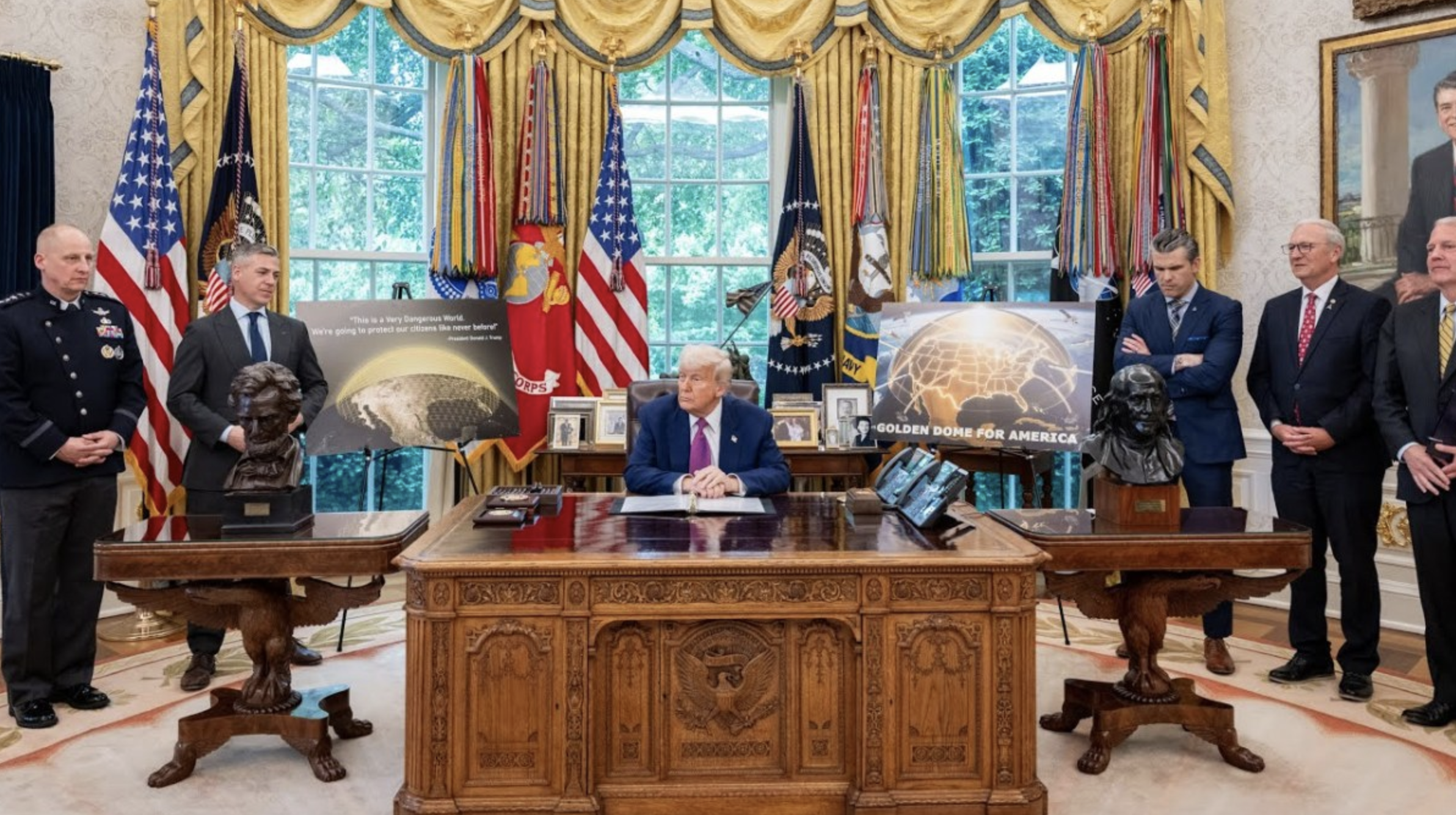
Donald Trump unveils proposed Golden Dome missile defence system, May 20, 2025/WH image

By Peter Jones

May 25, 2025

President Trump’s determination to build the so-called “Golden Dome” missile defence system raises fundamental questions for Canada. Should we participate or not? What consequences will a decision, either way, have for existing Canada-US defence relations, most notably NORAD (North American Aerospace Defence Command)? What consequences will it raise for Prime Minister Mark Carney’s stated desire to diversify away from our asymmetrical relationship with the US? These are not small issues.

Lost in the public discussion, thus far, is a nuanced appreciation of two facts: first, the Golden Dome is far from a certainty (indeed, detailed plans as to how it will work do not seem to exist yet, ditto for some of the technologies that will be crucial to its success.); and second, “participation” in this venture can take many forms.

Logically speaking, full participation would imply that Canadian military personnel would serve in the command and control of whatever system is eventually built, and we would share in the extraordinary costs of building and running it. But there may be more limited options. The way the issue was dealt with the last time it came up is instructive.

During the presidency of George W. Bush, the US decided to build a limited missile defence system. Bush wanted Canada to participate. Ultimately, Prime Minister Paul Martin decided not to, for a variety of political reasons. This decision raised issues. Canada very much wanted NORAD, the binational command that provides early warning and tracking of aerospace threats to North America, to continue. NORAD provides Canada with coverage of its territory at a fraction of the cost it would take us to do this by ourselves.

Significantly, NORAD implicitly achieves a measure of US recognition of our sovereignty in the North, for aerospace defence purposes at least, by establishing that the US NORAD presence there is part of a treaty-level arrangement that defines the territory as Canadian. This does not entirely solve the sovereignty problem, but it is better than nothing.

By opting out of participation in the Martin era, we faced a situation whereby the US would simply go its own way to develop the threat warning and tracking system on which that missile defence would rely. This would have eventually rendered NORAD obsolete. What we did in the Bush-Martin era was to square the circle.

We declined to participate in the missile defence system, but we agreed that NORAD should provide its early warning and threat tracking component. In effect, NORAD identifies and tracks incoming threats and Canadians are part of that process; but then the actual missile defence system takes over to try to engage those threats and Canadians are not part of that. We have long sought to thread the needle between detection and interception.

Fast-forward to President Trump’s Golden Dome and we face similar issues. Can we maintain NORAD’s benefits to Canada by finding a way to allow a modernized and more capable NORAD to provide the new system’s early warning and threat tracking capability, but not be part of the interception of the incoming missiles?

As we don’t yet know the details of the Golden Dome system, it is hard to say. For example, the architecture of President Bush’s more limited National Missile Defense (NMD) of several decades ago worked with all of the interceptor missiles based on US territory. Will that be the case today, or will the architecture of the Golden Dome require some of the interceptor missiles to be based in Canada, as well as in the US and in space? It is not yet clear, but, if some interceptor missiles have to be based in Canada for the system to work, a decision will have to be made to participate or not.

Moreover, the missile threat has evolved. Much more capable, long-range cruise missiles now pose a significant threat. Geography dictates that, even if their targets are in the US, they will fly over Canada. The US will never allow this threat to go unmet. If we don’t meet it, or cooperate with them to do so, they will meet it on their own and they won’t ask our permission.

Could Canada play a role in intercepting cruise missiles, but not in intercepting ballistic missiles? Can the two threats be separated from each other? If North America ever came under concerted attack, a potential enemy could launch both kinds of missiles to try to overcome defences. Can one have two entirely different command systems, one for cruise missiles and one for ballistic missiles, if those missiles are acting in concert?

These are some of the issues Canadian officials are likely grappling with. They need to figure out what is vital for Canada to participate in for our own interests, and what could be left to the US alone without threatening our sovereignty. And they need to do this in the overall context of a wider Canada-US relationship that has gone from stable over many decades to more hostile, uncharted territory that is inherently unpredictable.

We do have control over the question of whether and how we ‘participate’, and we should not assume that ‘participation’ in the system is necessarily an all-or-nothing affair.

This last point is especially crucial. President Trump’s fascination with the Golden Dome may be this week’s plaything, or it may be a lasting policy. His methods of achieving it may, or may not, hew to political and diplomatic norms with respect to things like our sovereignty — which he has already questioned anyway. When the costs of the system mount, as they are expected to do quite spectacularly, much of it may be quietly “postponed”, particularly if his tariff and other economic policies lead to a deep recession and the US cannot borrow on the bond markets to finance its endless debt.

Much of the project may prove a chimera in the end. Any real estate developer trying to sell the promise of a “big, beautiful building” to come (someday, if the land can be acquired, and the regulatory barriers overcome, and the money can be found at the right rates), will always try to make a hard sell to investors before ground is broken.

Of course, there are wider issues. Will the Golden Dome actually work perfectly, as the Trump administration says it will, and be operational before he leaves office in three years, as he says it will? Most experts think not. Will it stimulate a new arms race as Russia and China seek to overcome this new defence by building more missiles? Most experts think it will.

And, if we opt to fully participate in the system, and parts of it are eventually based in space (as preliminary designs call for), will participation mean abandoning our long-standing, treaty-based, opposition to weapons in space? What will other countries, those with whom we hope to diversify our relations, think of that? If we go all-in on this system, can we still diversify defence relations more broadly?

These higher-order questions are serious, though some of them are probably ones over which Canada doesn’t have much control. But we do have control over the question of whether and how we “participate,” and we should not assume that “participation” in the system is necessarily an all-or-nothing affair. Nor should we assume that the system Trump imagines in his frequently changing mind is the one that will ultimately be built in the decades to come.

Depending on how it is designed, participation could take the form of doing largely what we do in NORAD today — provide early warning and tracking of incoming threats. Or it could require a much deeper and more active level of engagement. Until we know where all of this is going, maybe the protection of the NORAD mission, and its benefits to Canada, is the prudent play.

If, under a different president in a future time, once the system is more fully understood and the Oval Office is a more stable place, Canada’s interests will be served by a more fulsome participation that can be revisited. President Trump may decry this approach as insufficient, but we have something he needs; our geography. As senior US military personnel have made clear before Congress, the system’s early warning requirements cannot be met without Canadian participation.

Defence experts and contractors who support such participation will be looking to get in on the ground floor, and will no doubt say that a firm decision about full membership is required today; that decisions are being made now as to what the system will look like and we need to be inside the room if we are to be full players. Some may also quietly argue that whether or not the system works someday in the future is not the main issue right now; we need to show the US that Canada is a serious ally on defence and signing up for this signature project will do that. Perhaps.

But this is tantamount to signing up for a decades-long project which will cost hundreds of billions of dollars without really knowing whether it will work or what our ultimate role will be in whatever is finally produced, if the system is ultimately built at all. It requires a leap of faith to imagine today that our defence interests will always be absolutely congruent with those of the US and that it is a prudent decision to commit to this now, when so much about our relationship with the Americans is so uncertain. As Prime Minister Carney has said, America under Donald Trump is not the reliable ally it once was.

If the decision is made to pursue an alternative to immediate full participation in the Golden Dome, finding a way to gently sell this will not be easy. In the context of broader discussions over tariffs and future economic and security arrangements, Canada’s representatives will have to tiptoe carefully around the issues. As is so often the case in diplomacy, the question is not whether you say “yes,” or “no,” but how you say it; which doors you close and which ones you leave partially open for another day.

Whichever way we go, it is crucially important that we be deadly serious about getting to 2% of GDP for defence quickly, or even beyond 2%. A failure to join the Golden Dome wholeheartedly, if coupled with an ongoing failure to meet this NATO spending commitment would be fatal to any credibility we might have. As part of that, the ongoing costs of modernizing NORAD, which will not be insignificant, cannot be skimped on.

If we are going to make our willingness to see NORAD play the role of threat detection and tracking the cornerstone of our approach to the Golden Dome, an approach that lands at “slightly less than full participation, but not quite rejection either,” we have to show that we are fully committed to doing an outstanding job on the NORAD mission.

Peter Jones is a Professor in the Graduate School of Public and International Affairs at the University of Ottawa.

EN / FR