CNANW

The Canadian Network to Abolish Nuclear Weapons | Le Réseau canadien pour l’abolition des armes nucléaires

Statement: “Nuclear Disarmament in Times of Unprecedented Risk”


Five Recommendations Arising From the Roundtable

On October 24, 2024, Canada’s four leading nuclear disarmament organizations—the Canadian Pugwash Group, the Canadian Network to Abolish Nuclear Weapons, Canadians for a Nuclear Weapons Convention, and Project Ploughshares—convened an expert Roundtable on “Nuclear Disarmament in Times of Unprecedented Risk.” This was held in response to rapidly escalating nuclear threats. The convening organizations share the profound conviction that Canada must urgently reassert its voice and leadership in the global disarmament arena.
 
The gravity of today’s nuclear threats, underscored by the heightened possibility of nuclear weapons’ use, demands that Canada act with bold urgency. In our Report, we call on the Government of Canada to reaffirm its role as a constructive middle power by embracing these recommendations. By doing so, Canada can strengthen its legacy of peacebuilding and advance the imperative of nuclear disarmament in times of unprecedented risk.  Read the report here: ND4 Report to GoC 2024

Canadians for a Nuclear Weapons Convention Award Lecture by Tariq Rauf

Ending the Perpetual Menace of Nuclear Weapons


“Following the Trinity nuclear test detonation of 16 th July 1945, nuclear scientist Leó Szilárd observed that, “Almost without exception, all the creative physicists had misgivings about the use of the bomb” and further that “Truman did not understand at all what was involved regarding nuclear weapons”. These days, the movie Oppenheimer has been the rage based on a noteworthy biography of Robert Oppenheimer entitled American Prometheus written by historians Kai Bird and Martin Sherwin. Though the movie spares its viewers the horrors of the atomic bombing of Japan, it does reflect the warnings of the early nuclear weapon scientists about the long-term or permanent dangers of a nuclear arms race and associated risks of further nuclear weapons use. On the other hand, the film overlooks other historical works including A World Destroyed: Hiroshima and its Legacies also by Martin Sherwin, that disputes and negates the US government’s narrative about the necessity of using nuclear weapons twice over civilian targets in Japan and suggests that the decisions were driven mainly by geostrategic and prestige considerations – criteria still in operation today to justify continuing retention of nuclear weapons.”

Read on: Tariq Rauf: Ending Perpetual Menace of NW 

Today’s Wars No Excuse to Abandon Disarmament

Download statement in pdf


Published in The Hill Times, November 1, 2023

For the first time, the four leading organizations in Canada devoted to nuclear disarmament issues — Canadian Pugwash GroupCanadian Network to Abolish Nuclear WeaponsCanadians for a Nuclear Weapons Convention and Project Ploughshares — co-sponsored a single event on Oct. 19, 2023. This extraordinary Roundtable, “Revitalizing Nuclear Disarmament Afer the Ukraine War,” was convened at a moment of extreme danger to the world. This is the Roundtable’s abridged report to the Government of Canada.

Full Report, Canada’s Role in Nuclear Disarmament in a Multi-Polar World: After Ukraine Special Roundtable

“NWC Reset: Frameworks for a nuclear-weapon-free world”

Brief comments at the NPT side panels
(by Robin Collins, Co-chair, Canadian Network to Abolish Nuclear Weapons)
August 9, 2022 by Zoom

“Don’t let your reticence with one approach for the sake of alliance solidarity be the excuse of convenience that you use to justify not proceeding with another.

A colleague in Canada recently asked us to imagine that day when “You wake up to the news that the last remaining warhead has been dismantled. The era of nuclear weapons is over.”

We know he wasn’t being overly optimistic, because he then offered a list of many of the hard cases and sticky problems that obstruct us: the nuclear sharing policies of NATO; North Korea; Iran; the nuclear weapons states outside the NPT, and all those NPT obligations and expectations that to a large extent are unfulfilled or are openly violated. 

He was urging us to be realists and to consider the complementarity of options.

The point is that the specific vehicle must defer to the desire and commitment by states to accomplish the abolition. What will inspire the political will to end the existential threat hanging over us all? What are the unnecessary obstacles?

As nuclear weapon abolitionists we can make the project of abolition and the replacement security framework coherent and as palatable as possible so that when the road is cleared, or clearer, things can as easily as possible fall into place. Which package, or options picked, is far less important. What counts is that the goal is pursued in earnest.

As Jackie Cabasso, one of our Abolition 2000 working group members said earlier at the NPT as an NGO representative — considering the ignoring of NPT commitments from 1995, 2000 and 2010, it’s time to refocus our attention on the nuclear-armed states. A time-bound target for abolition is overdue. Jackie said: we “call on the nuclear-armed and nuclear sharing states to commit to a timeframe of no later than 2030 for the adoption of a framework, package of agreements or comprehensive nuclear weapons convention, and no later than 2045 for full implementation”.

The Nuclear Weapon Convention Reset paper that our Abolition 2000 working group constructed, has this approach, which is to highlight the three primary options that are under consideration: Then it is up to the official and unofficial Nuclear Weapon States, NATO members and NATO umbrella states to proceed.

Proceed swiftly. 

Canada, my country, has no nuclear weapons although was involved in the nuclear bomb project from the early days, and is a member of NATO, along with three nuclear-armed states, five others with nuclear-sharing arrangements[i] and seven others that participate in Support of Nuclear Operations With Conventional Air Tactics (known as SNOWCAT).[ii] 

We are fully aware of the pressures on NATO members towards their being compliant and in solidarity with other NATO members, to go along with the prevailing winds – and therefore also the reluctance to push back or be that nuclear nag (once again). This is still the case, particularly in the most delicate of moments, by which I mean the current context of the Russian illegal invasion of Ukraine: the sabre-rattling rhetoric, the references to actual use of nuclear weapons. Not to mention the daily killing and dying. But just as the New START talks need to continue, now more than ever, so is this a good time for states to speed up, not slow down, progress on abolition.

Countries like Canada may have been involved at the Stockholm Initiative, a diplomatic forum that proposes risk reduction measures and a “stepping stones approach” to nuclear disarmament; or attended The Vienna Conference on the Humanitarian Impact of Nuclear Weapons this last June, but then avoided the TPNW like the plague, despite pressure from disarmament activists and many parliamentarians.

We are here pragmatically advocating for nuclear weapon states and NATO members to consider the options for disarmament that you can stomach. If not the TPNW with protocols, then a nuclear weapons convention or a framework of instruments. Don’t let your reticence with one approach for the sake of alliance solidarity be the excuse of convenience that you use to justify not proceeding with another. 

Some leader or leaders need to step up within NATO to break the silence and expose the illusory consensus, and begin the renewal of the abolition project, because, as the UN Secretary-General said, “Luck is no strategy!”

Our “Nuclear Weapons Convention Reset: Frameworks for a nuclear-weapon-free world” message, therefore, highlights this complementarity of three possibilities towards a time-bound abolition target, for de-escalation of the unhelpful rhetoric, for urgent risk reduction measures, and ultimately for a sustainable peace and common security wherein nuclear threats and nuclear weapons no longer exist. 

Thank you for your time.


[i] Belgium, Germany, Italy, the Netherlands and Turkey

[ii] Czech Republic, Denmark, Greece, Hungary, Norway, Poland and Romania

Reducing the Nuclear Weapons Risks in the Ukraine Conflict

Report on November 29, 2022 Special Meeting of CNANW

In a recent statement, NATO’s Secretary General, a former social-democratic Norwegian Prime Minster, Mr. Jens Stoltenberg said that the alliance will continue to support Ukraine for “as long as it takes”. He added: “We will not back down.” Prominent columnists have challenged the very idea that a ceasefire in the Ukraine crisis is possible or have even suggested that it might lengthen the war on Russian President Putin’s terms. Some press for a “fight to victory” by Kyiv, given recent gains on the battlefield. Sometimes the nuclear weapons threat is seen as blackmail, a bluff, or a risk worth ignoring.

How then can Canada constructively contribute to peace?

Panelists at the CNANW discussion in late November were asked to consider opportunities for reducing the nuclear weapon threat, and prospects for peace. All acknowledged the dire situation in Ukraine following the illegal Russian invasion.

How Many Intensive Care Beds Will A Nuclear Weapon Explosion Require?

Tom Sauer and Ramesh Thakur

A novel coronavirus emerged in Wuhan, China late last year, hopping in one way or another from other animals to humans. Initially the rest of the world thought this outbreak was a local problem and then was shocked at the brutality of the lockdown that the Chinese authorities clamped on Wuhan to quarantine the infection cluster. Despite China’s efforts at containment, soon the virus rode the highways and byways of globalisation to quickly circle the world. Other countries realised their hospital systems could be overwhelmed unless they drastically slowed the surge of new infections. No country had the number of beds in its intensive care units (ICUs) to manage patient loads under worst-case scenarios of letting this new coronavirus spread through the community to acquire herd immunity.

To those of us whose primary professional interest lies in nuclear weapons and the dangers they pose, the coronavirus pandemic is a striking validation of the Humanitarian Initiative, which took off 10 years ago with three core propositions: First, no country individually has the capacity to cope with the humanitarian consequences of a nuclear war, and the international system doesn’t have it collectively, either. Second, it is therefore in the interests of all humanity that nuclear weapons never be used again, under any circumstances. And finally: The only guarantee of non-use is the complete elimination of nuclear weapons. These precepts were the powerful impetus behind the Nuclear Weapons Ban Treaty that 122 states at the United Nations adopted in July 2017.

The pandemic speaks to the truth of the first proposition about the power of the bomb. The near-universal response to the panic created by COVID-19 leads us to the conclusion that the number of ICU beds needed to deal with a disaster should become a new norm, and a new way to judge when radical action is needed to respond to a global threat. So what other types of global catastrophes could call for more hospital infrastructure and personnel than is now available? The bomb is one obvious answer. Are the number of ICU beds sufficient to respond to a disaster caused by the explosion of one nuclear weapon or, in a war, many? No, they are not sufficient. Not even close.

A serious threat assessment consists of estimating the size of a threat and its probability. For the nuclear threat, estimating the size is rather straightforward; the probability is more difficult. A nuclear cataclysm is low probability in the short term, almost certain in the long run, and high impact whenever it happens. Let’s put it another way: For nuclear peace to hold, deterrence and fail-safe mechanisms must work every single time. For nuclear catastrophe to occur, either deterrence or fail safe mechanisms need to break down only once. This is not a comforting equation. Moreover, deterrence stability depends on rational decision-makers being always in office in every single nuclear-armed country. The leaders of the nine countries with the bomb today—China, France, India, Israel, North Korea, Paki- stan, Russia, the UK, and the United States—do not universally reassure on this score.

So let’s take the number of available intensive care beds as the new measure and apply it to potential nuclear catastrophes. With the help of Stephens Institute of Technology researcher Alex Wellerstein’s Nukemap, we can model the approximate results of a hit on a target city by a nuclear warhead of choice. The largest bomb tested by Pakistan—which has a yield equal to 45 kilotons of TNT—would kill 358,350 people and injure 1.28 million, if used in an airburst over Delhi. But there would almost certainly be many more injuries; almost four million people live within the 7 kilometre radius in which the detonation would break glass windows and create other “light” blast effects—which actually are not light and would cause major injuries. If Russia launched one of its nuclear-armed, 800-kiloton Topol missiles against NATO headquarters in Brussels, Belgium, 536,180 people would die and 572,830 would be injured. If a 5,000-kiloton Chinese Deng Fong-5 missile reaches Brussels, 839,550 will die and another 876,260 people will be seriously injured. Belgium’s 1,900 ICU beds (minus those of Brussels and surroundings, which would of course be instantly destroyed or rendered unusable) could not begin to cope with a humanitarian disaster of this magnitude. And what if more than one nuclear warhead explodes? What about a nuclear war that produces dozens or hundreds of nuclear explosions?

No society is prepared for such a man-made disaster. Worse, no society can ever be prepared for such a scenario. Nevertheless, many nations (including our home countries of Belgium and Australia) base their defense policies on the threat that the United States will use nuclear weapons in their defense, if necessary.

We cannot predict when and with what ferocity the next global pandemic will hit. But we can be certain that Covid-19 will not be the last pandemic disease to afflict humanity, and we should be making preparations to forestall such a disaster. We also cannot predict when and where nuclear weapons will be used again, and by whom. But we can be grimly confident that a nuclear warhead will be detonated someday, somewhere, if not by choice and design, then inadvertently, through accidental launch, rogue launch, or system failure.

Nuclear deterrence has proven itself to be anything but foolproof. Syria and Egypt attacked Israel in 1973, even though the Jewish state possessed nuclear weapons; in 1991, Iraq’s Saddam Hussein also disregarded Israel’s nuclear arsenal, firing Scud missiles at Tel Aviv. Argentina attacked the nuclear-armed UK in the Falkland Islands war. India and Pakistan, both nuclear powers, fought the Kargil war in 1999 (more than 1,000 people died) and had a dog-fight in February last year. We would not call these conflicts—any one of which might have resulted in the use of nuclear weapons—expressions of security or stability. A policy based on hope and luck (as US Secretary of Defense Robert McNamara described the conduct of the Cuban Missile Crisis) cannot be the basis of a serious defense policy.

What is the probability of a nuclear war or simply the explosion of a single nuclear weapon? Certainly it is more than zero. And the probability seems to be rising rather than falling. If US President Donald Trump does not extend New START by the end of this year, for the first time in 50 years the world will end up without any bilateral arms control treaty that includes verification. The nuclear-armed countries have not negotiated one new arms control treaty since 2010. North Korea now has nuclear weapons, and Iran may be the next in line.

The world is facing a clear threat of an “outbreak” of nuclear weapons proliferation.

As of now, there are no treatments or preventive measures that work against the new coronavirus circling the world. But a “vaccine” against nuclear weapons use already exists— the Treaty on the Prohibition of Nuclear Weapons, often known simply as the Nuclear Weapon Ban Treaty. Unfortunately, despite their legal obligations under Article 6 of the Nuclear Non-Proliferation Treaty (NPT), the five nuclear weapon states and their allies, and also the four nuclear armed states outside the NPT, are refusing to take the prophylactic medication the ban treaty prescribes. The nuclear weapon “haves” refuse to give up their nuclear privileges, even though they promised to do so under the NPT. The US alone will spend $50 billion this year on the maintenance and modernisation of nuclear weapons and their delivery vehicles.

Doctors know better. They know that they won’t be of any help in a nuclear war. That is why the World Medical Association stands behind the Nuclear Ban Treaty since 2018. The same for the World Federation of Public Health Associations, the International Council of Nurses, and International Red Cross.

The world has experienced epidemics and pandemics before. It suffered but endured. The coronavirus pandemic too shall pass, and life will go on. But the world is unlikely to return to the pre-pandemic state of affairs. Countries will rebuild domestic manufacturing capacity for critical medical supplies and equipment and create institutional structures to manage a surge in ICU capacity for future epidemiological crises. They will rebuild some vital border protections. And they will build functional redundancy into global supply chains to reduce exposure to single points of critical supply.

But such measures will not work as preparations against a nuclear war; no infrastructure, no matter how sophisticated or extensive, could cope with the horrible injury toll. Using ICU beds as a new norm informs us that no after-the-fact response to a nuclear bomb explosion can work. So prevention in the form of the Ban Treaty vaccine must be universally administered. In the post-pandemic world, therefore, eliminating nuclear weapons must be a top priority of the utmost urgency.

  The Authors      

Tom Sauer is an Associate Professor in international politics at the Universiteit Antwerpen in Belgium. Sauer is a former fellow at the John F. Kennedy School of Government, Harvard University. He received the 2019 Rotary International Alumni Global Service Award.

Ramesh Thakur is Emeritus Professor in the Crawford School of Public Policy and Director of the Centre for Nuclear Non-Proliferation and Disarmament, Australian National University; Senior Research Fellow with the Toda Peace Institute; and a former United Nations Assistant Secretary-General.

  Toda Peace Institute    

The Toda Peace Institute is an independent, nonpartisan institute committed to advancing a more just and peaceful world through policy-oriented peace research and practice. The Institute commissions evidence-based research, convenes multi-track and multi-disciplinary problem-solving workshops and seminars, and promotes dialogue across ethnic, cultural, religious and political divides. It catalyses practical, policy-oriented conversations between theoretical experts, practitioners, policymakers and civil society leaders in order to discern innovative and creative solutions to the major problems confronting the world in the twenty-first century (see www.toda.org for more information).

Notes: 1. This article was first published in the Bulletin of the Atomic Scientists, 28 April 2010 https://thebulletin.org/2020/04/how-many-intensive-care-beds-will-a-nuclear-weapon-explosion-require/

Contact Us

Toda Peace Institute
Samon Eleven Bldg. 5th Floor
3-1 Samon-cho, Shinjuku-ku, Tokyo 160-0017, Japan Email: contact@toda.org

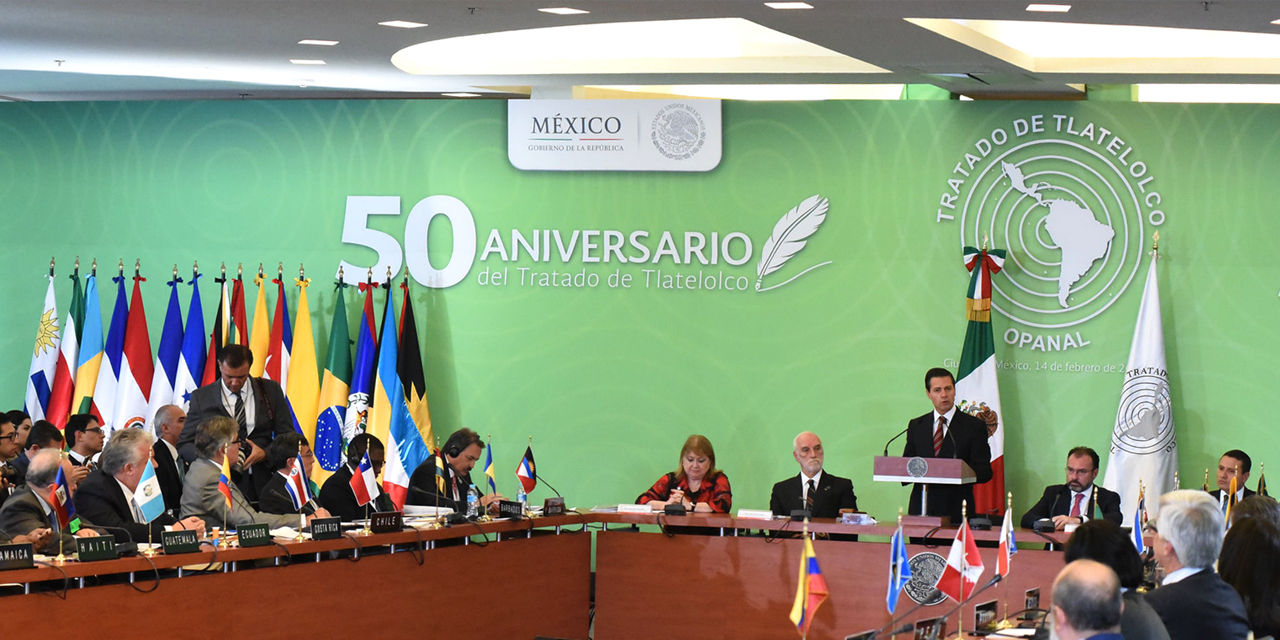
Jaramillo: Latin America and the Quest for Nuclear Abolition: From the Treaty of Tlatelolco to the Ban Treaty

photo credit: OPANAL

On February 14, 2014, as the Second Conference on the Humanitarian Impact of Nuclear Weapons came to an end, conference Chair Juan Manuel Gomez Robledo—then deputy Minister of Foreign Affairs of Mexico—captured the sentiment in the room in the powerful last few words of his closing remarks: in global efforts toward the elimination of nuclear weapons, this conference marked a “point of no return.” His optimistic conclusion was met with a roar of applause.

Read further: here 

Statements


  • Restoring Canada’s Nuclear Disarmament Policies Expert Seminar, February 2008:
    • Event Report (english, pdf)
    • Statement (english, pdf)
    • Séminaire d’experts sur la restitution de leadership Canadiene sur le désarmement nucléaire
    • Déclaration (pdf)

    • Text Box: Vers 2010: Priorités en vue d’un consensus à propos du TNP
      • Rapport de l’Initiative des puissances moyennes, Avril 2007
        [MPI Statement to Standing Committee on Foreign Affairs]
      • Mémoire de l’Initiative des puissances moyennes en prévision de la réunion du Comité préparatoire du TNP qui aura lieu à Vienne, en 2007 [rtf; pdf]

    • Canadians Call for End to Nuclear Weapons in NATO/Des Canadiens exigent la suppression du recours à l’armement nucléaire par l’OTAN:


EN / FR